There is an unsettling rhythm to Nigeria’s rainy season. While downpours bring relief to farmers longing for a bountiful harvest, for millions living in vulnerable corridors across the country, storm clouds signal an immediate race against time. Within hours, heavy rains can turn arterial roads into raging rivers, submerge homes, paralyze commerce, and tragically claim lives. But this rainy season, a quieter, more critical story is unfolding one that begins long before the first drop of floodwater touches the soil.
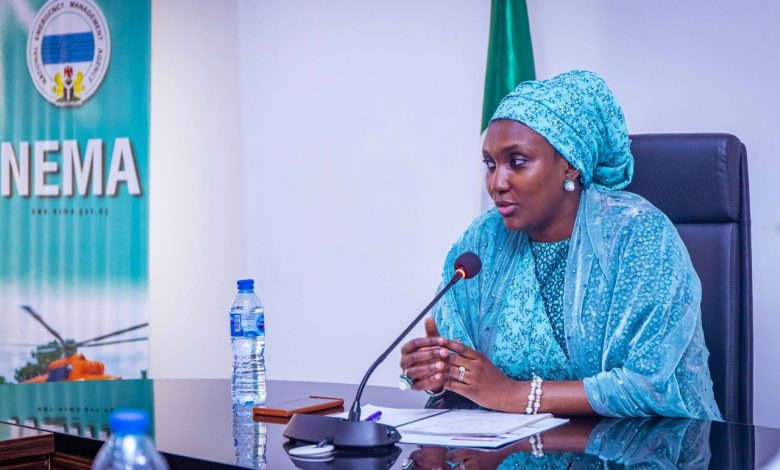
For the National Emergency Management Agency (NEMA) and its Director-General, Zubaida Umar, the ultimate test is no longer just how the agency manages a crisis after it strikes. It is how early a warning reaches a rural farming community, how swiftly federal and state institutions align, and how much can be done before a foreseeable hazard explodes into a full-scale national emergency.
Emergency management in Nigeria has traditionally been defined by the aftermath: rescue operations, evacuation logistics, temporary camps, and post-disaster relief distribution. While these interventions remain indispensable, modern disaster risk reduction demands anticipation. When the 2026 Seasonal Climate Prediction was released back in February, Zubaida Umar wasted no time urging stakeholders to translate dry meteorological data into practical, localized climate-risk strategies.
The underlying principle is stark: a weather forecast sitting in an air-conditioned Abuja office saves no one. It must trigger immediate action on the ground. That ethos gained formidable institutional muscle in June when Vice President Kashim Shettima directed the activation of NEMA’s Fusion and Trigger Room a dedicated nerve center designed to coordinate anticipatory action against climate hazards before they breach critical thresholds.
Translating high-level strategy into grassroots survival requires radical, inter-agency coordination. In July, Zubaida Umar forged deeper operational integration with the Nigerian Army, securing crucial backing for engineering support, logistics, and rapid search-and-rescue. She also prioritized simulated flood exercises to stress-test response readiness. A simulation lacks the dramatic optics of a live rescue operation, but its value is unmatched: it exposes dangerous operational bottlenecks from malfunctioning communication lines to flawed evacuation routes while there is still time to fix them.
That proactive stance extends directly to the grassroots. As rainfall intensified, NEMA ramped up public awareness campaigns, urging residents in flood-prone states to heed relocation warnings, avoid crossing swollen currents, and clear blocked community drainage channels. Crucially, the Agency locked arms with State Emergency Management Agencies (SEMAs), local emergency committees, and traditional rulers. A national early-warning system is only ever as strong as its final link: the citizen who hears the alert and actually moves out of harm’s way.
Information architecture is equally vital to this shift. On August 4, Zubaida Umar activated NEMA’s National Emergency Operations Centre to streamline real-time monitoring and coordination. In crisis management, fragmented data breeds fragmented responses. The objective is clear: turn raw data into instant decisions, and instant decisions into saved lives. Under her leadership, the agency is also pivoting toward space-based digital modeling and advanced risk mapping, ensuring that relief supplies represent the final safety net rather than the opening move of a reactive cycle.
To be sure, NEMA cannot command the weather, nor can it single-handedly overhaul Nigeria’s massive infrastructure deficits or stop unregulated construction on natural waterways. Disaster management remains a shared, multi-layered responsibility spanning federal, state, and local tiers of government down to individual citizens. But someone must connect the data to the decision, and national policy to the vulnerable community. That is where NEMA’s evolving framework proves indispensable.
The unfolding narrative is not merely about how NEMA rescues Nigerians in distress; it is about how successfully Zubaida Umar is moving the nation upstream spotting risks early, communicating them clearly, and acting decisively before tragedies occur. No institution can promise an entirely disaster-free nation. The realistic benchmark is a country where fewer warnings are ignored, fewer communities are caught off guard, and fewer natural hazards escalate into humanitarian disasters.
Ultimately, the true measure of a serious disaster management agency is not how spectacularly it responds after the flood, but how quietly and effectively it succeeds before it. For Zubaida Umar and NEMA, the race against the rains is already in motion. The real question now is whether the rest of the country will run with them.
22 August 2026


